Categories
Uncategorized

How Storytelling Affects The Brain & The Narrative We Tell Ourselves Impacts on our Daily Mood

Something so simple as the stories, the beliefs and the narratives that we tell ourselves, have a crucial part to play in affecting our moods on a long term basis. So, if I was to ask you how many times you say self-critical things to yourself, would you say that it is a regular occurrence in your life?

Through the counselling work that I do, it is clear that for many, the ‘inner voice’ that speaks within them, is one that is largely self-critical, harsh and ‘rules based’. It includes statements like, “I am not good at that”, or, “I can’t do this and I feel deficient”, or worse still, “I am useless and just wasting my time”. For many people, other ‘rules based’ thoughts are the root cause of their never ending anxiety and low moods; as though they are running against a treadmill in life that never stops giving putting negative thoughts in their way.

Having stringent internalised rules in the way that we speak to ourselves creates mental inflexibility and this can lead to mental health problems. It is therefore important to remember that the more mentally flexible we are, the greater our sense of well-being and our ability to deal with stress.

For example, how many of us take a ‘rules based’ approach to ourselves on a daily basis and say statements like this; “I must do this otherwise I will feel like a failure”. Alternatively, how about, “I should have done this earlier, what is wrong with me’. These two statements demonstrate the harshness that many of us speak to ourselves with and with each statement, we convey a sense to ourselves that we are deficient, incapable or lacking in some way. We would never say some of the things to others that we say to ourselves. It is as if, just because we speak to ourselves, we can be brutally harsh to ourselves.

Instead, one of the things I always say to clients is to be more self-compassionate with themselves. So for example, take the following statement, “I should have done this earlier and I am wasting time”, could be re-addressed internally by saying, “I would have liked to have done this earlier, but I understand that other things came in the way. I will try and get this done later”.

You can see the stark difference between the two statements and the way that one plays into a harsh sense of self-criticism. The more we do this to ourselves on a daily basis, the more we undermine our sense of self and our belief in ourselves, both of which lead to lower moods and higher anxiety states over time.

So, next time you catch yourself saying something critical about yourself, try ‘stepping back’ in your mind and just giving yourself the space to be able to rephrase any critical self-talk. Give yourself the space by adapting your language which can create a sense of mental flexibility, forgiveness and self-compassion. Remember, be kind to yourself in the  way that you speak to yourself. It is truly the least that we can do for ourselves.

Categories
Uncategorized

Seeking Reassurance to Cope with Anxiety Simply Re-Enforces Anxiety

I really keep having to ask for re-assurance” said Ellie in the counselling session with me.

I just need that re-assurance and I need to know that things will be o.k. It helps to reduce the sharp anxiety that I feel about certain things“, she went onto say.

Ellie is not alone in wanting and seeking out re-assurance about specific thoughts, feelings or even images that come up in her mind and body. Seeking constant re-assurance is one of the behaviour patterns that people with an anxiety condition have. It can be classed as a form of self-soothing, reducing anxieties that come up in the mind of someone with this condition. This is a form of managing the anxiety that an intrusive thought or a fear may bring up in the mind of an individual. Re-assurance is therefore a form of defense, developed early in the life of a child as a coping strategy. However, much like any coping strategy, it may have been useful at the time, however, it does not seem to work as an individual gets older and it becomes restrictive for many people. They get bound into this same practice of re-assurance giving that reduces their ability to enjoy life or new experiences and it ultimately keeps them engaged in a cycle of re-assurance seeking, worry, doubt and high anxiety, that goes round the same loop again.

So what should be done by someone with an anxiety condition if they feel that they need ongoing re-assurance? As I said earlier, re-assurance seeking is a defensive behaviour aimed at overcoming a feeling of overwhelming distress. Well, the first thing, is to do the opposite. You may feel a real need for re-assurance as a thought may be causing you to ruminate with high and distressing anxiety levels. However, don’t seek that re-assurance and let yourself sit with’ and go through the anxiety process so that you feel so that you can get some distance between the desire for re-assurance and the thought naturally dropping in intensity as time passses.

One of the negative feedback loops set up early in anxiety conditions, is to try and seek re-assurance at the earliest moment. All this does is to re-enforce the belief that the thought is so overwhelming and dangerous, that such defensive tactics are essential. It can also be translated internally by an anxiety sufferer as a form of ‘weakness’ and with the subsequent impacts on the self-esteem of individuals dropping over time. In other words, an individual with anxiety and re-assurance seeking behaviours feels different and somewhat ‘less than’ others. This also further compounds the problem and the confidence of the individual.

So if re-assurance is your ‘go to’ place for safety seeking attention, the chances of overcoming a specific, thought or image are low because the re-assurance seeking behaviour entrenches the thought and gives it greater legitimacy. Also, to seek out re-assurance would undermine your true and authentic self and a belief that you are very likely, the master of your safety and security; that you have ‘capital’ in the decisions and choices that you make in your life.

Categories
Uncategorized

Risk Scanning and Management OCD with Anxiety | Counselling 4 Anxiety

We know that anxiety conditions have a possible genetic and biological trait, as well as environmental and experiential factors. This ‘tripod’ of issues means that in some ways, there is real progress that can be made in treating anxiety conditions. The environmental and experiential factors can be adapted and changed and so hope is essential in the therapeutic process and in engagement with individuals who have anxiety and who are looking for help through counselling or hypnotherapy support.

Part of the symptomology of anxiety conditions is the belief that individuals over-estimate issues of risk to themselves or their family or futures, and under-estimate their ‘ability to cope’ with adverse events.  This leads to a marked inclination towards believing that bad things are more likely to happen. For example, in Obsessive Compulsive Disorder, (which is classed as an anxiety disorder), mental ruminations are inclined to focus on negative historical events or ones that may happen in the future. The cognitive fusion with these beliefs is something that OCD sufferers easily slip into and therefore this ability to slip into negative ruminations around previous or even future events, is observable in clients with OCD. This is also why people who have OCD, say that they slip easily into their ruminative thoughts and why they feel ‘stuck’ within them. What they are also unknowingly doing by resisting thoughts or going through ‘problem solving ruminations’, is that they are re-enforcing the brain pathways and the behavioral patterns around anxiety, which have led them down a specific rabbit hole in the first place.

As I said before, people with anxiety conditions tend to internally over-emphasize the impact that a negative event or incident will have on their lives. Linked into this, is a strong sense of responsibility, that they can prevent harmful or negative things happening to them, their families or loved ones.

What Can Therapists Do?

Counsellors and therapists can work with individuals on examples where they have been able to be resilient and where they have gotten  through situations that were difficult. Working with clients on such events helps them to refocus on their gains, though this also has to go hand in hand with assessing and bringing to the surface any negative core beliefs that they might have. Without work on their negative core beliefs, any subsequent work may not have a long lasting effect for the client.

Also, working with them to assess the actual risk of a future event that they deem will be catastrophic should be part of the therapeutic package of work. In many cases, the actual risk will be much smaller than the client perceives and therapists should explore what is the worst that can happen, how realistic it is in happening, how likely the client is to get through the situation and the means and mechanisms that they can employ to go through it. Allied to this work should include a form of acceptance that the situation may be difficult and that it may generate difficult feelings, though there is a path through the mental haze that the client can follow and go through

It is also essential to explore the deep sense of responsibility that clients with anxiety have and therapists should also explore which life events may have led to this behavioral trait and construct a form of graded exposure which is brought into the work. This will assist clients to gently learn to live with uncertainty. This should help them to grasp any growing belief that they are not responsible for bad things which may happen to them or to their loves ones; that in fact, bad things happen in life and it is about learning to live with this, accept that it is part of life and embrace the chance to use a variety of practical tools that they can manage their anxiety with.

Lastly, sessions should also explore the core values that matter for clients. This allows therapists to help them focus on their values, as a means of implementing them in their lives whilst also acknowledging core positive elements about themselves. It also helps some clients become motivated and to give them a sense of perspective around things that they can work towards.  ‘Values’ work should therefore not be an after-thought in any counselling package that is devised with the client. It need to be part of the ongoing work, meaning that it is also essential to any healing process.

Categories
Uncategorized

Acute Feelings of OCD and Hyper Responsibility | Counselling 4 Anxiety

There are many triggers and underlying psychological factors that aggravate OCD (Obsessive Compulsive Disorder). One of them is feelings around heightened responsibility that people who have OCD feel, and who then attempt to take actions to meet this feeling of ultimate responsibility.

For example, people with OCD feel that they can change catastrophic or difficult future events by carrying out some type of action, as though they alone can change the outcome for someone or people they love, solely by their actions. I stress ‘their’ since they truly believe that a thought about something disastrous happening to someone they love can be changed if they take responsibility and do something about it. This could be by moving something, or stepping away from a crack in the pavement or if they carry out another action. We could describe these actions as magical thinking, but we should not under-estimate how much people who have the condition get caught up in the obsessive and compulsive behaviours, because they believe that they can make a difference to the outcome.

They therefore take matters upon themselves and this acute sense of responsibility, of being able to do something to change an outcome, (even though they realistically have no real control over the outcome of an intrusive thought), is something that should be worked through with clients who are experiencing OCD ruminations or behaviours.

For example, a client that I worked with who is a teacher, had been under pressure to fill in UCAS and university references for young people applying to university. She also felt the need to let students access her as much as possible during their breaks, and felt an acute sense of responsibility for their professional futures. These two elements went together hand in hand.

This led to her feeling more anxious, thereby fuelling her sense that she was critical to a positive outcome and had to do more, leading to a cycle of stress, anxiety and hopelessness. This ultimately led to intrusive thoughts which increasingly exacerbated the situation. The levels of responsibility had therefore formed an underpinning thought pattern that ultimately led to higher stress and anxiety levels, which then created the environment for intrusive thoughts to affect her.

Exploring feelings and levels of responsibility are therefore areas of work which should be conducted by therapists working with people who have OCD.

Categories
Uncategorized

Anxiety Can Affect Us at This Time of Conflict Between Gaza and Israel

At this time, the crisis in the Middle East is affecting many communities in our country. Some people are glued to social media and their ‘X’ feeds, meaning that they are exposed to heightened partisanship, dehumanising statements and videos of young children and men and women bleeding and dying. The partisanship is driving some people to make more and more absurd statements in their desire to propagandise and in some cases, spread disinformation. This has impacts on the mental health of those who are glued to their social media feeds and news sources. Exposure to such material can also deeply affect the values that people have, sometimes shocking them so much that they feel a generalised sense of anxiety, as though the world feels very unsafe at the moment.

What is even worse is that many of Britain’s Jews have close family contacts in Israel, whilst many British Muslims are deeply affected by what is happening in Gaza. So this is very personal for many people. The emotional umbilical cords to the region are deep and very present.

Which is why it is important to limit the amount of time on social media and to be mindful of mental health changes that include increasing frequencies of feelings of despair, residual stress and a creeping sense of hopelessness and loss of interest in life. The longer people are exposed to online feeds and to the appalling partisanship and anger that comes from platforms such as ‘X’, the greater the possibility of longer term emotional impacts on people.

It is also important to note that the more people stay on their social media feeds, the more exposed they are to being drawn into inflammatory and stress causing discussions. The fact is that many algorithms are built to draw in observers so that they comment on things. This has a positive feedback loop by playing on their desires to feel accepted, heighten their sense of validation and thereby becoming part of a ‘pack’ or crowd. Another problem with this is that it heightens the neural reward networks in our mind and plays on many of the same pathways that are involved in addictions. With the activation of such neural networks comes impulsivity and the potential of wider impacts on a person’s life if they make a comment that can affect their social standing, their employment or their friendships.

I also have to add that many are feeling apprehension at this point and this is also fuelling anxiety in many individuals. This is particularly the case with those who have family or friends in Israel and Gaza.

It is interesting to note that for those British Jews that I have spoken to, they are increasingly feeling fearful of their future in Britain. They are also deeply angry and reflective of the 1,200 Israelis murdered by Hamas and they are therefore caught up ruminating on where they may truly feel safe. Feeling like you have no real stake in the future, undoubtedly super-fuels anxiety at a personal and communal level.

For those British Muslims that I have spoken to, whilst this is a generalisation, many speak of anger for the destruction wrought on Gaza and for the children and civilians being killed in large numbers. When the two communal responses are put together, the fight or flight response has been super-activated by the conflict and it is clear to see why there is so much anxiety, anger and fear that is flowing through many people at this time.

Which is why we as therapists can play a critical role at this time in listening to clients who bring up these issues in therapy. At the very least, with anxious clients, we should gently probe that these world events are not layering on another burdensome level on their anxiety.

Categories
Uncategorized

CBT for Anxiety: Pushing Through the Anxiety Curve | Counselling 4 Anxiety

One core tool in helping people with anxiety to reduce their phobias and fears, is to use exposure therapy which is a key tool that is used with CBT (Cognitive Behavioural Therapy). The two go hand in hand and have a greater efficacy and outcome for people with anxiety and phobias when used together.

As therapists and counsellors, it is important to work with clients to ascertain what coping mechanisms they currently use. Getting a clear understanding of current coping mechanisms and techniques is essential in working through with clients, whether these coping mechanisms are helpful, (more than likely not at this stage in their life), or whether they may consider alternative coping strategies.

What may have been useful earlier in their lives, may not be working now and that is usually why people seek help from counsellors at a specific stage in their life.

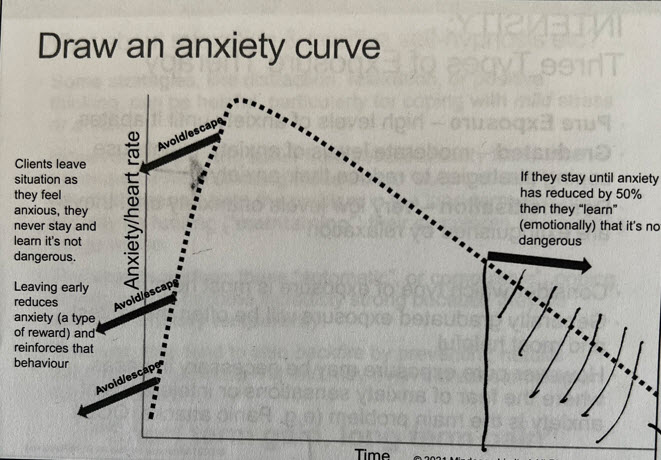
One element of psycho-educational work carried out with anxiety sufferers is to go through the ‘anxiety cycle’ with them and to demonstrate to them that exposing themselves to their fear, (like travelling on the underground), will cause their anxiety to rise though the body cannot maintain this anxiety and stress response for a long period of time. Anxiety and stress usually fall within 5-10 minutes of an individual staying within the phobia causing position.

So someone with a phobia of being in an underground carriage should stay on the carriage for a period of time when they feel that their anxiety and their heart rate has sufficiently and significantly fallen from the anxiety peak that they felt when they first got onto the carriage, or when they first arrived at the entrance to the Underground station.

The ’emotional and mental health’ learning takes place in the downward phase of the anxiety curve when an individual feels that their heart rate or their anxiety has dropped to about half the rate that it was when compared to the peak. It is at this point where the learning has an impact on the individual and where they start to recognise that their body or their mind is resilient enough to cope with the stressor or phobic situation.

For some people with anxiety, simply knowing this is a major step forward. It is therefore one tool in a range of many that should be used with people with ongoing anxiety and phobias.

(Note: The anxiety diagram used in this article is referenced to Mindease Limited and they are the creators of the anxiety curve map).

Categories
Uncategorized

Understanding the Cycle of Anxiety and How to Get Better | Counselling 4 Anxiety

One of the maintenance factors for anxiety is when an individual does not fully go through the anxiety cycle and where their safety behaviour patterns kick in, such as avoidance behaviours, the suppression of thoughts and other safety seeking behaviours. We all know that avoidance, the suppression of thoughts and safety seeking behaviours just strengthen and maintain anxiety over the long-term and make real internal and life-changing behavioural changes much more harder over time.

So what do I mean by the anxiety cycle? Well in a nutshell, this includes the ‘build-up’ to an event that an individual focusses on and which is causing a sharp rise in anxiety related behaviours. This event itself may include specific actions such as taking a flight, travelling on the underground or sitting in an enclosed space that feels claustrophobic.

Part of the anxiety cycle will also include the event itself, though the degree to which an individual places themselves into that event will determine if their anxiety or their phobias related to their anxiety strengthen themselves and are sustained, or weaken over time through continued exposure.

This obviously depends on how long someone can feel comfortable, for example, by travelling on a plane or sitting in tunnels and carriages on the London Underground. The quicker they get off these modes of transport as a form of avoidance to their sharply rising anxiety, the more their anxiety and the phobic/intrusive thoughts will remain a driving force for their safety seeking behaviours. ‘Cutting out’ early or as fast as possible to anxiety causing situations simply re-enforces and embeds in the anxiety cycle to a much deeper level. This is key to understand and comprehend and it is ego-dystonic.

Research work has shown that such individuals should stay in their anxiety causing situation until the intensity of their anxiety drops below 50% from the start. This can be measured in the form of their pulse or their heart rate and provides somewhat of a measure as to how long the person should stay in that situation, and through which there will be some form of therapeutic gain as the body re-learns that the situation is not catastrophic.

So, anxiety sufferers should repeatedly place themselves into specific situations that are anxiety producing, and stay in those situations until their heart rates fall to below 50% of the frequency of their pulse before they started the activity. Consistency is key, as is repeating these exercises on a weekly basis.

The greater the frequency of these exposures and the smaller the time difference between these exposure events, the greater the chance of real long-lasting change in response to anxiety. Furthermore, the greater the chances the individual will have to be able to overcome any anxiety inducing events in a much shorter period of time. The positive knock-on benefits to this also include a higher level of self-confidence and self-esteem in individuals, which act as a counter-loop to the anxiety cycle.

So going through the anxiety cycle is one of the most essential of activities that anxiety sufferers can undertake. With that in mind, therapists need to be aware that sufferers will more than likely have a ‘fear of fear’. Being curious with the client at the start of the counselling journey can ascertain this, before any exposure related behaviours can form part of any therapeutic planning process.

Categories
Uncategorized

Panic Attack and Anxiety Attack: Panic Attacks Do Not Mean a Life of Anticipation

‘The fear of fear’ is what one individual said to me.

“All I do now is to fear the fear of panic and that is adding a whole load of anxiety to me, that I just don’t need”.

For those who experience panic attacks, there is a real desire for many not to think about the ‘fear of fear’. Yet, this is what their ruminations and thoughts latch onto. Which is why exploring how individuals have coped with previous anxiety producing situations is key, so that they start to reflect on their resilience and their ability to cope with panic in the future. Yet, the word ‘coping’ does not fully describe the reality, that those who have panic disorder, should be supported in working through the panic events so that they can see that the anxiety process reduces over a short period of time, that they have got through it and that previous coping mechanisms that they have employed do not have to re-engaged with.

Previous coping strategies may in  fact be perpetuating the fear and thereby the panic and anxiety itself.

So talking through how anxiety is not harmful is important as part of the psycho-education process. As is the need to normalise anxiety – that it is a natural body reaction used to defend us and that those who have anxiety and panic attacks, have an over-sensitive and over-reactive sympathetic nervous system. Reducing the ‘fear of fear’ is therefore important which has a knock on effect of reducing thoughts and feelings that the individual is somehow ‘faulty’ or ‘significantly different’ than the general population.

Another way of anchoring clients who ruminate and who reflect on the past, is to help them to catch themselves and be mindful when they start to go into the ruminatory cognitive process. Staying in the present and the ‘here and now’ and noticing 5 things around them, is a useful way of anchoring them in the present moment, helping them to engage with the world around them and with nature itself. It is anxiety reducing and helps to make people feel that they are part of something larger and wider than them. This process is one of a number of tools to help sufferers of panic attacks to slowly build a mindset that accepts and lives with mental flexibility, rather than the inflexibility of mindset that anxiety creates.

Lastly, breathing techniques, and learning to let thoughts ‘come and go’ – much like leaves on a stream, are other useful tools that people with anxiety and panic attacks can use. These are all mechanisms that I use within my therapy sessions with clients.


Categories
Uncategorized

How Hypnotherapy Can Help Manage Social Anxiety? – Counselling 4 Anxiety

Social anxiety affects many people and is very treatable through counselling and hypnotherapy.

Allied with social anxiety are behaviours that include avoidance, stress that is sometimes felt in the shoulders, arms and back muscles and sensations such as blushing. Cognitive thoughts could include, “am I able to cope”, “this will be embarrassing” or “I cannot look at people that I am presenting to”. Underlying these thoughts are core beliefs that I work with the client to uncover as a starting process to look at what is ‘underneath the bonnet’, driving such thoughts.

For some clients, core beliefs may include “I am not able to cope”, or “I am weak” and it is important for the client to be aware of these and to go through the psycho-educational process of understanding that they exist and that they can change their responses and the internal dialogue that they are having with themselves. It is at moments of stress, such as when they are giving a speech or a presentation, when the core beliefs can affect and develop thoughts that are anxiety inducing and affect the confidence of individuals.

Role plays and working through the internal dialogue that clients have, so that they can take a more compassionate approach to internal narratives, can help them to train, manage and weaken the core beliefs. It also gives them the space for them to reflect on language that can build and support their resilience and which can be embraced by them as the scaffolding to overcome their social anxiety.

Repeating this process of reappraising their core beliefs, deconstructing them and reflecting with clients as to whether they have any actual substance or not, are an essential part of the re-appraisal process. Furthermore, gently placing the client into those moments, (such as getting them to visualise that they are going to give a speech), and using breathing and muscle tension and relaxation exercises, provide additional tools that clients can use, whilst chipping away at any cumulative anxiety that may be building up if they are going to give a speech in the future.

Social anxiety is therefore one of the spectra of anxiety conditions where we as therapists can make a real difference  to the client’s resilience. In today’s world, where there are more work pressures and where greater duties at work are expected from staff, reducing social anxiety makes significant gains for clients emotionally, mentally and economically. It also raises their sense of self-achievement and more importantly, their sense ‘that they can cope’.

Social anxiety is therefore based on an internal defensive reaction and it is not the anxiety that is at the root of the issue. Whilst client’s will feel discomfort and focus on the anxiety symptoms around societal engagement, at the root of this is what the client believes about themselves and what a specific social engagement will do to them. These are the driving forces which are at the root of social anxiety. Focussing on these, whilst providing anxiety reducing tools, are a roadmap for a future where client’s can widen the scope of life experiences and with it, a greater joy in life.

Categories
Uncategorized

Cognitive Distortions In Anxiety: Role of Therapists – Counselling 4 Anxiety

Specialising in anxiety conditions such as generalised, social anxiety and obsessive-compulsive disorder has demonstrated to me how deep and ingrained cognitive distortions are in people who have suffered long-term anxiety. This is also a problem with people who may have had anxiety-related cognitions for less than five years and this depends on the strength of belief in the distorted cognitions that individuals have.

I stress this again and it is not necessarily the length of time that someone has suffered from anxiety conditions, it is the strength of believability in the cognitive distortions that pulls in people and which then hyper-fuels and stimulates a sensitised limbic system and the amygdala.

What has also been missing in many therapeutic interventions is around curiously working with clients around understanding how cognitive distortions affect many of the sensory functions of sufferers. Smell, sight (shades of colour), touch and even taste become fused in certain circumstances with distorted thoughts and these fusions are often missed in work that is done in therapy.

Therapists need to take a much wider view of the variety of sensory systems that are affected by cognitive distortions, as well as how believable the thoughts are for clients. In not addressing these sensory and cognitive fusions, therapists may miss out on how sensory stimulations and reactions keep cognitive distortions alive.

The fact is that short-term work on getting clients to understand and work on accepting alternatives to their cognitive distortions is important. Yet, many therapists do not ensure that the work is central to their therapy and many move into the framework of getting the client to understand their triggers and their family history or traumas. All of this is essential work in giving clients a wider understanding of how they have reached this point, but the point that I am trying to make is that the cognitive distortions still remain as deeply ingrained in many and continue to cause real problems for people.

Allied to this, very subtle behaviours that go with the cognitive distortions as a means of coping with them further fuel and enhance their relevance to anxiety sufferers and many of these subtle actions will not be noticeable to therapists.

Approaches in therapy that seek to let clients find alternative thinking patterns to their cognitive distortions are essential. It allows them to take ownership of alternative ways of thinking that can resonate with them. However, it is important that therapists use their natural sense of curiosity in getting clients to think as widely as possible so that they are armed with a range of alternatives that they can turn to.

Therapists should also provide psycho-education to clients to ensure that they do not use alternative interpretations of their cognitive distortions as a crutch which they automatically return to when they are anxious. This may keep the anxious thoughts alive and alternative narratives to their cognitive distortions are simply to be used as a means of getting them to think about alternatives that may ‘stick’ with relevance. This is subtle work, yet important.

Finally, this is subtle and nuanced work. Many of us are willing to tick a box to say that we can work on anxiety conditions; the truth is, are we really able to work with the complexities and range of anxiety conditions there are?

counselling near me

Get in Touch