
Categories
Uncategorized

Acute Feelings of OCD and Hyper Responsibility | Counselling 4 Anxiety

There are many triggers and underlying psychological factors that aggravate OCD (Obsessive Compulsive Disorder). One of them is feelings around heightened responsibility that people who have OCD feel, and who then attempt to take actions to meet this feeling of ultimate responsibility.

For example, people with OCD feel that they can change catastrophic or difficult future events by carrying out some type of action, as though they alone can change the outcome for someone or people they love, solely by their actions. I stress ‘their’ since they truly believe that a thought about something disastrous happening to someone they love can be changed if they take responsibility and do something about it. This could be by moving something, or stepping away from a crack in the pavement or if they carry out another action. We could describe these actions as magical thinking, but we should not under-estimate how much people who have the condition get caught up in the obsessive and compulsive behaviours, because they believe that they can make a difference to the outcome.

They therefore take matters upon themselves and this acute sense of responsibility, of being able to do something to change an outcome, (even though they realistically have no real control over the outcome of an intrusive thought), is something that should be worked through with clients who are experiencing OCD ruminations or behaviours.

For example, a client that I worked with who is a teacher, had been under pressure to fill in UCAS and university references for young people applying to university. She also felt the need to let students access her as much as possible during their breaks, and felt an acute sense of responsibility for their professional futures. These two elements went together hand in hand.

This led to her feeling more anxious, thereby fuelling her sense that she was critical to a positive outcome and had to do more, leading to a cycle of stress, anxiety and hopelessness. This ultimately led to intrusive thoughts which increasingly exacerbated the situation. The levels of responsibility had therefore formed an underpinning thought pattern that ultimately led to higher stress and anxiety levels, which then created the environment for intrusive thoughts to affect her.

Exploring feelings and levels of responsibility are therefore areas of work which should be conducted by therapists working with people who have OCD.

Categories
Uncategorized

Anxiety Can Affect Us at This Time of Conflict Between Gaza and Israel

At this time, the crisis in the Middle East is affecting many communities in our country. Some people are glued to social media and their ‘X’ feeds, meaning that they are exposed to heightened partisanship, dehumanising statements and videos of young children and men and women bleeding and dying. The partisanship is driving some people to make more and more absurd statements in their desire to propagandise and in some cases, spread disinformation. This has impacts on the mental health of those who are glued to their social media feeds and news sources. Exposure to such material can also deeply affect the values that people have, sometimes shocking them so much that they feel a generalised sense of anxiety, as though the world feels very unsafe at the moment.

What is even worse is that many of Britain’s Jews have close family contacts in Israel, whilst many British Muslims are deeply affected by what is happening in Gaza. So this is very personal for many people. The emotional umbilical cords to the region are deep and very present.

Which is why it is important to limit the amount of time on social media and to be mindful of mental health changes that include increasing frequencies of feelings of despair, residual stress and a creeping sense of hopelessness and loss of interest in life. The longer people are exposed to online feeds and to the appalling partisanship and anger that comes from platforms such as ‘X’, the greater the possibility of longer term emotional impacts on people.

It is also important to note that the more people stay on their social media feeds, the more exposed they are to being drawn into inflammatory and stress causing discussions. The fact is that many algorithms are built to draw in observers so that they comment on things. This has a positive feedback loop by playing on their desires to feel accepted, heighten their sense of validation and thereby becoming part of a ‘pack’ or crowd. Another problem with this is that it heightens the neural reward networks in our mind and plays on many of the same pathways that are involved in addictions. With the activation of such neural networks comes impulsivity and the potential of wider impacts on a person’s life if they make a comment that can affect their social standing, their employment or their friendships.

I also have to add that many are feeling apprehension at this point and this is also fuelling anxiety in many individuals. This is particularly the case with those who have family or friends in Israel and Gaza.

It is interesting to note that for those British Jews that I have spoken to, they are increasingly feeling fearful of their future in Britain. They are also deeply angry and reflective of the 1,200 Israelis murdered by Hamas and they are therefore caught up ruminating on where they may truly feel safe. Feeling like you have no real stake in the future, undoubtedly super-fuels anxiety at a personal and communal level.

For those British Muslims that I have spoken to, whilst this is a generalisation, many speak of anger for the destruction wrought on Gaza and for the children and civilians being killed in large numbers. When the two communal responses are put together, the fight or flight response has been super-activated by the conflict and it is clear to see why there is so much anxiety, anger and fear that is flowing through many people at this time.

Which is why we as therapists can play a critical role at this time in listening to clients who bring up these issues in therapy. At the very least, with anxious clients, we should gently probe that these world events are not layering on another burdensome level on their anxiety.

Categories
Uncategorized

CBT for Anxiety: Pushing Through the Anxiety Curve | Counselling 4 Anxiety

One core tool in helping people with anxiety to reduce their phobias and fears, is to use exposure therapy which is a key tool that is used with CBT (Cognitive Behavioural Therapy). The two go hand in hand and have a greater efficacy and outcome for people with anxiety and phobias when used together.

As therapists and counsellors, it is important to work with clients to ascertain what coping mechanisms they currently use. Getting a clear understanding of current coping mechanisms and techniques is essential in working through with clients, whether these coping mechanisms are helpful, (more than likely not at this stage in their life), or whether they may consider alternative coping strategies.

What may have been useful earlier in their lives, may not be working now and that is usually why people seek help from counsellors at a specific stage in their life.

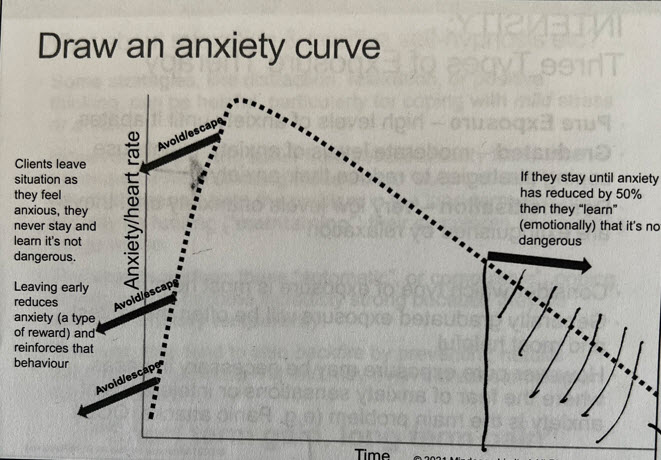
One element of psycho-educational work carried out with anxiety sufferers is to go through the ‘anxiety cycle’ with them and to demonstrate to them that exposing themselves to their fear, (like travelling on the underground), will cause their anxiety to rise though the body cannot maintain this anxiety and stress response for a long period of time. Anxiety and stress usually fall within 5-10 minutes of an individual staying within the phobia causing position.

So someone with a phobia of being in an underground carriage should stay on the carriage for a period of time when they feel that their anxiety and their heart rate has sufficiently and significantly fallen from the anxiety peak that they felt when they first got onto the carriage, or when they first arrived at the entrance to the Underground station.

The ’emotional and mental health’ learning takes place in the downward phase of the anxiety curve when an individual feels that their heart rate or their anxiety has dropped to about half the rate that it was when compared to the peak. It is at this point where the learning has an impact on the individual and where they start to recognise that their body or their mind is resilient enough to cope with the stressor or phobic situation.

For some people with anxiety, simply knowing this is a major step forward. It is therefore one tool in a range of many that should be used with people with ongoing anxiety and phobias.

(Note: The anxiety diagram used in this article is referenced to Mindease Limited and they are the creators of the anxiety curve map).

counselling near me

Get in Touch